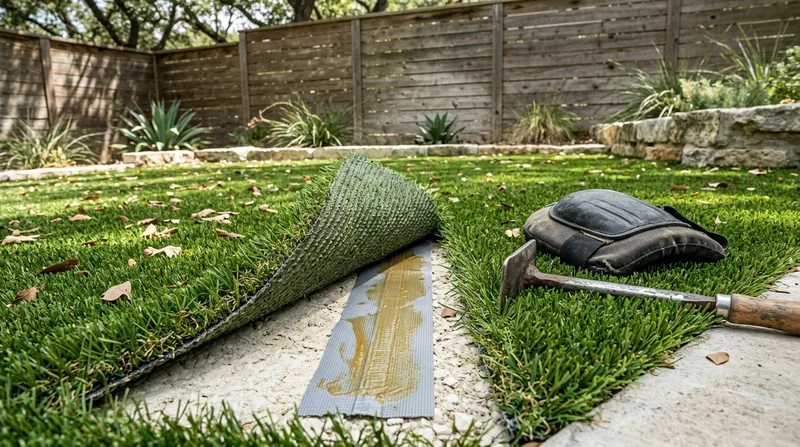




Artificial turf installed in Austin's demanding climate faces real wear: seams separate, edges lift, infill compacts, and the Hill Country sun can fade or melt sections where window reflections concentrate heat. Turf repair and seam repair in Austin keeps your investment functional and safe, whether the turf is five years old or fifteen. We handle separated seams, flattened traffic lanes, small holes, patched areas, and edge re-securing on yards across Austin, West Lake Hills, Lakeway, and the surrounding Hill Country. Unlike patch-and-hope crews that glue down a scrap and move on, we name the infill, test the base, and re-seal seams to manufacturer spec so the repair lasts as long as the original install. If your turf is showing its age, a targeted repair can add years to its life and cost far less than full replacement.
Why Seam Separation and Edge Lift Happen in Austin Turf
Seams fail when adhesive breaks down, when the base shifts under freeze-thaw or heavy rain, or when foot traffic and pet claws repeatedly stress the same joint. Austin's sudden summer storms can saturate poorly graded base, and the 100-degree heat cycles stress the backing material. Edges lift when the perimeter turf was not secured deep enough into the base or when tree roots, soil settlement, or water erosion undermines the edge. Flattened traffic lanes happen in high-use areas like pet runs and pool surrounds where the infill gets compressed and matted fibers lose their upright texture.
- Seam adhesive degrades after 8 to 12 years, especially in direct sun and high-use zones.
- Base settlement or water pooling beneath the turf causes edges to separate and seams to buckle.
- Pet claws, foot traffic, and furniture legs compress infill and flatten pile in concentrated areas.
- Window reflections and metal roof glare can melt or discolor small sections of polyethylene turf.
- Improper initial installation (shallow edging, no proper base compaction) shows up as early failure within 2 to 5 years.
Each of these issues can be repaired without replacing the entire yard if caught early.
Key info: Austin's limestone soil and flash-flood storms mean water management under turf is critical. If your seams are separating or edges are lifting, the base may need re-grading or drainage improvement. We assess the cause before sealing seams, because a repair that ignores poor drainage will fail again.
How We Repair Turf and Reseal Seams in Austin
Our repair process starts with a site assessment: we identify the seam type (hot-melt or adhesive tape), check the infill and base condition, and confirm whether the failure is structural (base problem) or just surface wear. For seam repair, we open the joint, remove old adhesive, clean both edges, and re-apply hot-melt seam tape or polyurethane adhesive according to the turf manufacturer's spec. For edge lift, we secure the perimeter back into the base and reseal the edge seam. For flattened areas, we brush the pile to restore texture and top-dress with fresh infill if needed. For small holes or melt spots, we patch with matching turf and seal the perimeter. We document the work and provide a one-year warranty on the seam repair itself.
- We inspect the seam type, infill composition, and base condition before selecting repair materials.
- We remove old adhesive and debris, then re-seal with hot-melt seam tape or polyurethane adhesive matched to the original turf.
- We re-secure lifted edges by re-anchoring the turf backing into the base and resealing the perimeter joint.
- We brush flattened areas and re-infill with the same material to restore pile height and texture.
- We patch small holes or melt spots with matching turf cut from a salvage roll or off-cuts from a related project.
The entire process takes 2 to 4 hours for a typical seam or edge repair, and we can often complete the work in one visit.
Example: A homeowner in Rollingwood noticed the seam between two turf sections separating along their dog run after 7 years. The old adhesive had dried and cracked. We removed the old tape, cleaned both edges, applied new hot-melt seam tape, and re-infilled the joint with fresh antimicrobial zeolite. The repair took 3 hours and cost far less than replacing the entire pet turf. See our pet turf installation page for more on keeping dog runs in shape.
Repair Methods and When to Use Each
| Repair Approach | Description | Best for |
|---|---|---|
| Seam Re-Tape | Remove old adhesive and apply new hot-melt seam tape or polyurethane tape to join turf edges. | Separated seams, failed adhesive, visible gaps between sections. |
| Edge Re-Securing | Re-anchor the perimeter turf into the base and reseal the edge seam to prevent further lift. | Lifted edges, peeling corners, exposed base at yard perimeter. |
| Infill Top-Dress and Brush | Brush flattened pile and add fresh infill to restore texture and drainage in worn traffic lanes. | Matted areas, high-traffic zones, pet run compaction, faded appearance. |
| Small Hole or Melt Patch | Cut out damaged section and insert matching turf patch, then seal the perimeter seams. | Cigarette burns, window reflection melt spots, small tears or punctures. |
| Base Inspection and Grading | Assess base compaction and drainage, recommend re-grading if water pooling or settlement is causing seam failure. | Recurring seam separation, edge lift in rainy season, water pooling visible after storms. |
Choosing the right repair method depends on the failure mode and how long the turf has been in place. We diagnose the root cause on site so the repair addresses the real problem, not just the symptom.
Turf Repair and Seam Repair Cost in Austin: What to Expect
Seam repair in Austin typically starts at $350 for a single 10- to 15-foot seam re-tape, including removal of old adhesive, cleaning, and application of new hot-melt tape or polyurethane adhesive. Edge re-securing runs $300 to $600 depending on how much perimeter needs re-anchoring. Infill top-dress and brush work runs $200 to $400 for a typical pet run or high-traffic area. Small patch repairs (under 2 square feet) run $250 to $450. Multiple seams or a combination of repairs (seam plus edge plus infill) typically cost $600 to $1,200 for a residential yard. Base inspection and grading recommendations are included in the estimate, though major base work is quoted separately.
The main factors that move repair costs are the length of seams to repair, the turf type and infill (antimicrobial zeolite or recycled rubber infill affects material cost), accessibility, and whether base work is needed. For detailed pricing on your specific repair, see our full pricing guide or call us at (737) 273-9578 for a free on-site estimate within 24 hours. Getting 2 to 3 estimates is smart practice so you can compare not just price but approach: the lowest bid often skips the base inspection or uses generic adhesive instead of the turf manufacturer's spec, which means the repair fails again in 2 to 3 years.
What to Look for When Hiring a Turf Repair Company Near Me in Austin
When you call a turf installation company or independent turf installer for repair work, verify that they name the repair method and materials in writing before they start. Ask whether they will inspect the base and drainage, not just seal the seam. Request references from past repair jobs (not just new installations) and ask to see photos of completed repairs, especially seam work. Check that they carry a certificate of insurance naming general liability and workers' compensation. Understand whether your HOA has rules about turf appearance or color that might affect a patch or edge repair, and ask the installer whether they have experience with HOA submittals in your neighborhood.
- Verify the installer names the turf product, infill type, and adhesive or seam tape in the written estimate.
- Ask whether they will inspect the base and assess drainage or water pooling as part of the repair diagnosis.
- Request references from at least two past repair jobs and ask how long those repairs have held up.
- Confirm they carry current insurance and can provide a certificate naming general liability and workers' compensation.
- Ask about any HOA architectural rules that govern turf color, pile height, or edging, and whether they can help with an HOA submittal if needed.
The best indicator of quality is a written spec that names the product, the repair method, and a realistic timeline. Avoid crews that quote repair work by phone without a site visit or that promise lifetime warranties on seam work. For a free estimate, contact us online or call (737) 273-9578, and we will assess your turf on site and explain exactly what needs repair and why.
Turf Repair & Seam Repair in Austin: Pricing Guide
| Service | Price | Details |
|---|---|---|
| Single seam re-tape | Starting at $350 | Hot-melt seam tape or polyurethane adhesive applied to one 10- to 15-foot seam joint, includes removal of old adhesive |
| Edge re-securing | Starting at $300 | Re-anchor lifted perimeter turf into the base and reseal the edge seam, cost depends on how much perimeter length needs work |
| Infill top-dress and brush | Starting at $200 | Brush flattened pile and add fresh infill to restore texture in high-traffic or pet-run areas, typical job under 500 square feet |
| Small hole or melt patch | Starting at $250 | Cut and patch repair for damage under 2 square feet, includes matching turf and perimeter sealing, material and labor |
| Multiple repairs or combination work | $600 to $1,200 | Seam plus edge plus infill on a typical residential yard, includes base inspection and drainage assessment if needed |
| Free estimate | No charge | On-site assessment within 24 hours, written recommendation with materials and method named, no obligation to book |
Indicative pricing, the exact cost depends on square footage, finish, and site access. Free personalized estimate within 24h at (737) 273-9578.


