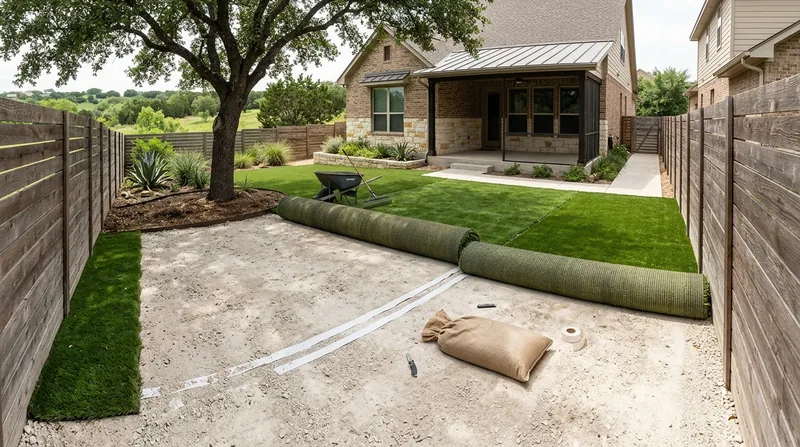




Residential Artificial Grass Installation in Austin transforms drought-stressed yards into durable, low-maintenance outdoor spaces that thrive in the Hill Country heat and clay soils. Austin's residential landscape spans from shaded Hyde Park bungalows and limestone estates in Westlake to post-war ranches in Allandale and new brick two-stories in Circle C, each with its own drainage challenges and HOA rules. Native St. Augustine lawns thin under 100-degree summers and hard clay, while live oaks and cedar elms create deep shade where grass simply fails. Artificial turf solves these problems without the water bill, the mowing cycle, or the frustration of bare patches. We've installed quality turf across Austin and the surrounding Hill Country since 2013, naming every product, face weight, infill type, and base depth in writing so you know exactly what you're getting.
Why Residential Artificial Grass Installation Matters in Austin's Climate and Terrain
Austin sits where rocky limestone slopes meet flat Blackland prairie, and that geology drives water and drainage problems that real grass cannot solve. Summer temperatures routinely exceed 100 degrees, St. Augustine lawns brown out despite irrigation, and heavy clay holds water in winter, creating root rot and bare patches. Many Austin lots are shaded by mature live oaks and Ashe junipers, making a healthy lawn impossible. Artificial turf installation eliminates the guessing game: it grows green year-round, needs no water during drought, and works in full sun or deep shade without decline.
- Eliminates summer watering bills and brown-out cycles tied to the Texas heat and clay soils.
- Survives full sun exposure on south and west-facing yards without bleaching or thinning.
- Works under mature live oaks, cedar elms, and Ashe junipers where natural grass fails.
- Provides a stable surface on limestone slopes and uneven terrain without erosion or washout.
- Resists the sudden heavy rain and flash-flood runoff common to the Balcones Escarpment region.
These factors make artificial turf installation a practical choice for homeowners tired of fighting Austin's climate and soil conditions.
Key info: Austin's HOA architectural rules commonly govern front-yard turf color, pile height, edging, and coverage. We help with HOA submittals and coordinate with your community guidelines, though final approval rests with your HOA board. We always recommend checking your CC&Rs and submitting samples before installation begins.
For detailed guidance on local regulations and best practices, see the City of Austin Development Services website, which covers grading, drainage, and right-of-way work that may apply to your property.
How We Install Residential Artificial Grass in Austin: Our Process
A proper artificial grass installation begins with site assessment and drainage planning, not a quick measure and a dump of turf on bare dirt. We evaluate your yard's slope, soil composition, water flow, and sun exposure to design a base that lasts. We request Texas 811 utility locates before any excavation to mark public utility lines, and we identify private lines (irrigation, low-voltage lighting, pet fencing) that locates do not mark. Base preparation is the foundation: we remove existing sod or debris, grade for proper drainage, compact the subgrade, and install a permeable base layer that allows water to flow through without pooling.
- We assess your yard's slope, drainage, sun exposure, and existing conditions to plan the right base depth and infill strategy.
- We request Texas 811 utility locates and identify private utility lines before any excavation work begins.
- We prepare the subgrade, compact it to specification, and install a permeable base layer for drainage and stability.
- We measure, cut, and seam the turf to fit your lot precisely, using reinforced seaming tape and adhesive rated for Austin's heat.
- We install the infill (sand, recycled rubber, or zeolite-based antimicrobial material) to the manufacturer's density and rake it level.
- We brush and fluff the pile, check all seams and edges, and walk the entire installation to verify quality before we leave.
This methodical approach ensures your turf lasts 12 to 15 years with only routine cleaning and raking.
Local example: A 1,200-square-foot yard in Circle C with south-facing exposure and clay subsoil requires a 4-inch compacted base, a high-quality face-weight turf rated for heat, and cooling infill to manage surface temperature. A shaded 800-square-foot lot in Travis Heights under live oaks needs a lighter-duty base and a different pile height to match the tree canopy and reduce sun stress. We specify each yard individually.
Learn more about how we handle complex terrain and drainage in our patio and balcony turf installation guide, which covers hard-surface base preparation and underlay techniques.
| Approach | Description | Best for |
|---|---|---|
| Full-yard removal and base prep | We remove existing sod or hardscape, excavate to proper depth, compact subgrade, and install permeable base layer for drainage. | Yards with poor drainage, heavy clay, or uneven terrain; new construction or major landscape renovations. |
| Shallow base on stable soil | We grade lightly, level existing compacted soil, and install a 2-inch permeable base for stable lots with good drainage. | Established yards with solid subsoil and no standing water; minimal excavation needed. |
| Patio, balcony, or rooftop turf | We install permeable underlay, secure edging, and seam turf on concrete, pavers, or decking without drilling or permanent fastening. | Hard surfaces where excavation is not possible; pool surrounds; rooftops; balconies; rental properties. |
| Partial repair or seam work | We patch damaged sections, re-seam lifted edges, and refresh infill in high-traffic areas without removing the entire installation. | Existing turf with localized wear, seam separation, or melted spots; budget-conscious maintenance. |
Residential Artificial Grass Installation Cost in Austin: What to Expect
Artificial grass installation in Austin starts at $8 per square foot for a basic residential yard with stable soil and straightforward drainage. That price reflects a quality turf product (face weight in the 50 to 65-ounce range), a permeable base layer, and standard infill. Costs climb when your yard requires deeper base preparation (clay soils, standing water, or steep slopes), when access is limited (narrow gates, mature trees, or tight spaces), or when you choose a premium turf product rated for extreme heat or enhanced durability. A 1,000-square-foot yard with standard conditions typically runs $8,000 to $10,000 installed. A 400-square-foot patio or pool surround with hard-surface underlay and reinforced seaming runs $3,500 to $4,500. Complex jobs on slopes, in shade, or with extensive base work need an on-site estimate; we measure, assess drainage, and quote in writing with the turf spec and base depth included.
Getting 2 to 3 estimates is smart. Compare the turf product name and face weight, the infill type and pounds per square foot, the base depth and compaction method, and the warranty on workmanship. A low price often signals thin base prep, low-quality turf, or incomplete site assessment. For a detailed pricing breakdown and examples for your specific yard size, see our full pricing guide.
Residential Artificial Grass Installation Near Me: What to Look for When Hiring a Turf Installer
Hiring a quality turf installation company near Austin means vetting for solid fundamentals: insurance, a written spec, local references, and finished work you can see. Ask any installer for a certificate of insurance naming general liability and workers' compensation coverage; a professional will provide it without hesitation. Request a written specification that names the turf product, face weight, pile height, infill type and density, base depth, and compaction method. Check references, ask to see photos of completed yards in Austin or nearby Hill Country neighborhoods, and drive by finished work if possible. Understand whether your lot requires a permit (most residential turf does not, but grading that changes drainage or work in a right-of-way may); your installer should defer to the local building department, not make promises. If you have an HOA, ask whether the installer has experience with architectural submittals and HOA coordination. A professional will be honest about what your yard needs and won't oversell you on features or promise a faster timeline than is realistic.
Call us at (737) 273-9578 or request a free estimate so we can assess your yard, answer your questions, and give you a detailed quote in writing.
Residential Artificial Grass Installation in Austin: Pricing Guide
| Service | Price | Details |
|---|---|---|
| Standard residential yard installation | Starting at $8/sq ft | Includes quality turf product, 2 to 4 inch permeable base, standard infill, and seaming on stable soil or minimal slope |
| Complex terrain, drainage work, or deep base prep | Starting at $10/sq ft | Includes excavation, subgrade compaction, permeable base layer 4+ inches, and site-specific drainage planning on clay or sloped lots |
| Patio, balcony, pool surround, or rooftop turf | Starting at $9/sq ft | Includes permeable underlay, edging, reinforced seaming on hard surfaces, no excavation, and installation on concrete or decking |
| Premium turf products or cooling infill | Starting at $11/sq ft | Higher face weight, heat-rated materials, or antimicrobial zeolite infill for pet yards or extreme sun exposure in Austin |
| Travel and estimate | Included in Austin service area | No separate mileage fee or travel charge within Austin and surrounding Hill Country communities; free on-site estimate within 24 hours |
Indicative pricing, the exact cost depends on square footage, finish, and site access. Free personalized estimate within 24h at (737) 273-9578.


