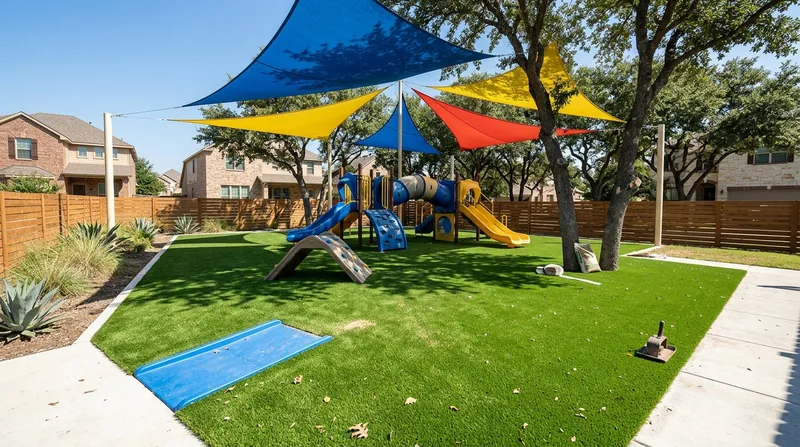




Playground and school turf in Austin demands a surface that withstands intense summer heat, heavy foot traffic, and the sudden downpours that sweep across the Hill Country. Austin's public and private schools, daycare centers, and recreational facilities face a hard choice: maintain a natural grass field that thins under 100-degree sun and turns to mud after a flash flood, or install synthetic turf that stays safe, playable, and accessible year-round. We design and install playground and school turf systems that meet safety standards, handle Austin's climate extremes, and reduce the maintenance burden on already stretched facility budgets. Our work covers fall-height requirements, proper infill selection, drainage design for the Blackland clay soils that dominate much of the Austin area, and compliance with local permitting rules. Since 2013, we have built turf fields for schools and recreation centers across Austin and the surrounding Hill Country communities.
Why Playground and School Turf Matters in Austin's Heat and Storms
Austin sits at the edge of the Texas Hill Country where summer temperatures regularly exceed 95 degrees and afternoon thunderstorms can dump two inches of rain in thirty minutes. Natural grass fields in this climate face two failure modes: drought stress that leaves bare patches by July, and waterlogging in clay soil that turns the field into a mud pit after a storm. Synthetic playground turf solves both problems. It provides a consistent, safe playing surface regardless of weather, eliminates the need for irrigation during drought, and drains quickly after heavy rain. Schools and parks can schedule activities without weather delays, and children have a reliable surface for recess, sports practice, and outdoor learning year-round.
- We select turf products and infill rated for fall-height safety standards required by ASTM F1292 and ASTM F1951 for playground surfaces.
- We design base layers and drainage systems that shed water through clay soil rather than pooling on the surface.
- We specify antimicrobial infill options that reduce odor and bacterial growth in high-traffic school environments.
- We work with school districts and facility managers to coordinate installation around the school calendar and avoid disruption to programs.
These steps ensure that playground turf in Austin stays safe, playable, and compliant with state and federal safety guidelines.
Key info: Austin schools in areas like Round Rock, Pflugerville, and Kyle face the same heat and drainage challenges. We have installed playground and school turf at elementary schools, middle schools, and recreation centers across the Austin metro area, with particular focus on drainage design for properties in the Blackland prairie where clay soil is dominant.
For more information on playground safety standards and turf specifications, see the ASTM International standards for playground surfaces, which define fall-height requirements and impact attenuation for synthetic turf.
How We Install Playground and School Turf in Austin
Playground turf installation is not the same as residential yard turf. The surface must meet safety impact standards, the base must handle high foot traffic and drainage loads, and the infill choice affects both safety and maintenance costs over the life of the field. We follow a documented process that begins with a site survey, moves through proper base preparation and grading, and ends with testing to confirm the turf meets the safety specifications your school or facility requires.
- We conduct a site survey to measure the play area, identify drainage patterns, and note any grading issues or utilities that affect installation.
- We remove existing turf or debris and grade the site to ensure proper water flow away from buildings and play zones.
- We install a compacted base layer (typically 4 to 6 inches of recycled asphalt or crushed stone) and test compaction to ensure stability under foot traffic.
- We lay the synthetic turf product specified for fall-height safety and acoustic performance, seaming edges with adhesive and fasteners.
- We apply the infill material (recycled rubber, virgin rubber, or antimicrobial zeolite blend) and brush it into the pile to reach the depth required for impact attenuation.
- We test the finished surface using a Clegg impact hammer or similar device to confirm fall-height compliance before we hand over the field.
This approach ensures that your playground or school field is safe, properly drained, and built to last 8 to 12 years with routine maintenance.
Example: A 4,000-square-foot elementary school play area in Austin required removal of a worn natural grass field, regrading to address clay soil that held water after storms, a 5-inch compacted base, and 45-ounce turf with antimicrobial infill. The project took eight working days and improved drainage so that the field was playable within two hours of a heavy rain, where the old grass field required three to five days to dry out.
For more details on how we approach turf removal and site preparation, visit our removal and replacement page.
Playground Turf Installation Methods and Specifications
| Approach | Description | Best For |
|---|---|---|
| Compacted Recycled Asphalt Base with Rubber Infill | 4 to 6 inches of recycled asphalt, compacted to 95% density, topped with 40 to 50-ounce turf and virgin or recycled rubber infill. | Elementary school playgrounds and recreation areas where budget is moderate and fall-height compliance is the priority. |
| Permeable Base with Antimicrobial Infill | Permeable geotextile over compacted stone, with 45 to 55-ounce turf and antimicrobial zeolite or treated rubber infill for odor and bacterial control. | High-traffic school fields, daycare centers, and areas where drainage and hygiene are critical concerns. |
| Shock-Pad Underlayment System | Foam or rubber shock pad layer beneath turf to increase impact attenuation, reducing fall-height requirements and improving player safety. | Middle and high school athletic fields, competitive sports areas, and facilities serving children with mobility challenges. |
| Hybrid Turf for Mixed-Use Fields | Combination of synthetic turf and paver strips or concrete zones for equipment placement, bleachers, or multi-sport use. | School athletic complexes serving multiple sports, and recreation centers with diverse programming needs. |
Each method is selected based on the facility's use pattern, budget, drainage conditions at the site, and the specific safety standards required by your school or municipality.
Playground and School Turf Cost in Austin: What to Expect
Playground and school turf in Austin typically costs between $12 and $18 per square foot installed, depending on site conditions, base preparation, and the turf product and infill selected. A 4,000-square-foot elementary school play area generally runs $48,000 to $72,000, while a 10,000-square-foot athletic field can range from $120,000 to $180,000. The largest cost drivers are base preparation (especially on sites with poor drainage or clay soil that requires deep regrading), the turf product specification (higher face weight and pile height cost more but last longer), and infill type (antimicrobial zeolite is more expensive than recycled rubber but reduces odor and maintenance in high-traffic areas). Travel within Austin and surrounding service areas is included in our estimate. We recommend getting two to three quotes from local turf installation companies so you can compare specifications, base depth, and the warranty on workmanship.
Visit our pricing page for a detailed breakdown of costs for different project sizes and scenarios. For a free, no-obligation estimate tailored to your school or facility, call us at (737) 273-9578 or request an estimate online.
What to Look for When Hiring a Playground Turf Installation Company Near Austin
Schools and facility managers should evaluate any turf installation company on the same criteria: proof of insurance, a written specification of the turf product and base system, references from completed school or playground projects, and photos of finished work in similar climates. Ask for a certificate of insurance naming general liability and workers compensation before work begins. Confirm that the company will test the finished surface using an impact hammer to verify fall-height compliance, and request a written report of those test results. Many schools have specific procurement rules or require competitive bidding, so be clear about timeline and approval processes upfront. If your facility has an HOA or architectural review board, discuss any color or appearance restrictions early in the planning process.
- Request a written specification naming the turf product, face weight, pile height, infill type and pounds per square foot, base depth, and compaction standard.
- Ask for three references from school or playground projects completed in the past three years, and call at least two to ask about drainage performance and maintenance costs.
- Confirm that the company carries workers compensation insurance and general liability insurance, and ask to see the certificate of insurance.
- Get a clear timeline and understand any school calendar constraints or weather delays that might affect the project schedule.
- Discuss warranty coverage on workmanship (typically one to three years) and understand what is and is not covered by the turf manufacturer.
A reputable turf installation company will answer these questions directly and provide documentation without hesitation. If a company refuses to put specifications in writing or cannot provide references, keep looking. For help evaluating contractors and getting multiple estimates, contact us to discuss your project and receive a detailed proposal.
Playground & School Turf in Austin: Pricing Guide
| Service | Price | Details |
|---|---|---|
| Elementary school play area (2,000-4,000 sq ft) | Starting at $12/sq ft | Compacted base, standard 40 to 50-ounce turf, recycled rubber infill, includes impact testing and compliance verification |
| Middle or high school athletic field (6,000-10,000 sq ft) | Starting at $14/sq ft | Reinforced base for heavy foot traffic, higher face weight turf, antimicrobial or virgin infill option, fall-height compliance testing included |
| Daycare or high-traffic recreation center turf | Starting at $15/sq ft | Premium antimicrobial infill, shock-pad underlayment for enhanced safety, drainage for clay soil, ongoing odor control |
| Complex site requiring extensive regrading or drainage work | On estimate | Clay soil removal, utility locates, grading to manage storm water, base preparation costs determined on site before final pricing |
| Travel and site survey | Included | No separate fee for projects within Austin and surrounding Hill Country service areas |
| Free estimate | No obligation | Response within 24 hours at (737) 273-9578, includes site walk-through and written specification proposal |
Indicative pricing, the exact cost depends on square footage, finish, and site access. Free personalized estimate within 24h at (737) 273-9578.


