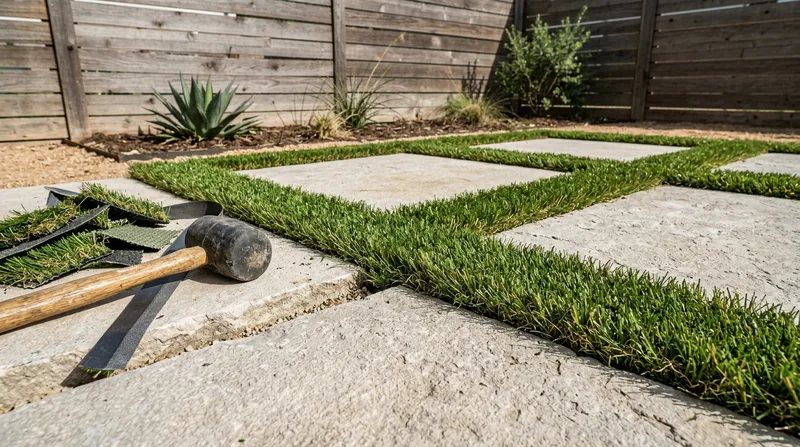




Austin's outdoor living spaces demand surfaces that handle intense summer heat, flash-flood drainage patterns, and the Hill Country's rocky terrain without the maintenance burden of natural sod. Patio, balcony and turf-paver strips transform concrete, stone, and hardscape areas into green, functional zones that stay cool underfoot and require minimal upkeep year-round. Whether you're installing artificial turf between limestone pavers on a Westlake estate, softening a small East Austin patio, or creating a low-maintenance transition on a downtown condo balcony, synthetic turf delivers durability and aesthetic control that real grass cannot match in our climate. From the Blackland prairie flatlands to the cedar-covered slopes around Barton Creek, artificial grass installations on hard surfaces solve the drainage and heat problems that plague patios in full sun. We've been installing turf in Austin since 2013, and we know exactly how to specify the right product, base, and drainage for every patio, balcony, and paver strip application.
Why Patio and Balcony Turf Works in Austin's Climate
Concrete patios absorb and radiate the Hill Country's relentless summer heat, making them uncomfortable to walk on barefoot and creating hot microclimates that stress nearby plants. Artificial grass on a patio or balcony provides a soft, cooler surface that stays green regardless of drought, 100-degree days, or the hard water and mineral deposits that stain natural sod. Paver strips between flagstone or limestone blocks give you the visual softness of a lawn without the root damage, drainage issues, or dead patches that plague narrow planted bands in heavy clay soil. Balcony turf is especially valuable for condo owners in downtown Austin or Lakeway who cannot install real grass at elevation and need a low-profile, lightweight solution that doesn't trap water or create maintenance headaches for neighbors below.
- Concrete patios in full Austin sun stay 30 to 50 degrees cooler with turf installed over a permeable base and drainage layer.
- Artificial grass eliminates the root damage and drainage failure that plagues natural sod planted in narrow paver strips on compacted clay.
- Balcony and rooftop turf is lightweight, non-penetrating, and drains to existing systems without creating pooling or mold risk.
- Turf-paver strips reduce maintenance to rinsing and occasional grooming, with no watering, fertilizer, or replacement cycles.
- Color and texture remain consistent through Austin's droughts and intense UV exposure, which bleach and thin natural lawns within years.
These installations solve real problems that Austin homeowners and property managers face every summer.
Key info: Austin's limestone patios and clay-heavy yards create poor drainage that leads to standing water, root rot, and algae growth on natural sod. Artificial turf with a proper base and underlay prevents water entrapment and keeps your patio usable even after the sudden flash-flood storms that hit the Hill Country in spring and fall. See our full residential artificial grass installation service for yard-wide applications.
For detailed permitting guidance specific to your patio location in Austin, check the City of Austin Development Services website, which covers grading and drainage requirements for hardscape projects.
How We Install Patio, Balcony and Turf-Paver Strips in Austin
Patio and balcony turf installation starts with understanding the existing surface, drainage patterns, and use case. On a concrete patio, we assess whether the slab is level, whether water pools in low spots, and what underlayment strategy will keep turf secure and well-drained. For balconies and rooftops, we confirm weight limits, confirm that drainage flows away from the building, and select a lightweight turf and base system that won't trap moisture or cause structural issues. Paver strips require careful substrate preparation so turf sits flush with stone edges, drains freely, and won't shift or separate over time.
- We inspect the existing patio or balcony surface and check drainage flow to identify pooling, settling, or water damage risk.
- We select a turf product and infill type matched to your climate exposure, foot traffic, and aesthetic preference, naming the face weight, pile height, and drainage profile in writing.
- We prepare the base by cleaning, repairing, and adding a permeable underlayment that prevents moisture entrapment and secures turf edges.
- We install turf using seaming and adhesive techniques that handle the thermal expansion of concrete and the movement of balcony structures.
- We edge the installation with trim, metal banding, or paver-integrated methods that match your hardscape and prevent turf from lifting.
Each installation is documented with a written spec that details product name, face weight, pile height, infill type and pounds per square foot, and base depth, so you know exactly what you're getting.
Example: A Circle C homeowner had a limestone patio that pooled water in one corner after heavy rain, killing native plants and creating a slip hazard. We removed the standing water risk by installing 1.5 inches of permeable base and a 65-ounce turf product with a reinforced drainage layer. The turf sits flush with the existing pavers, drains freely to the yard, and has stayed green and stable through three summers of 100-degree heat and two spring storms. See our turf repair and seam repair service if you need to address existing installations.
| Installation Type | Description | Best For |
|---|---|---|
| Concrete Patio Turf | Turf adhered to clean, prepped concrete with a drainage-friendly underlayment that prevents moisture pooling and thermal stress. | Patios in full sun, areas with poor drainage, or yards where real grass fails due to shade or clay compaction. |
| Balcony and Rooftop Turf | Lightweight turf and minimal-profile base system designed for elevation, load limits, and drainage to building systems without pooling. | Condos, lofts, and rooftop patios in downtown Austin or Lakeway where weight and drainage control are critical. |
| Turf-Paver Strips | Turf installed between flagstone, limestone, or concrete pavers with edge trim and reinforced seaming for durability and clean aesthetics. | Narrow planted bands, transition zones between hardscape and yard, or decorative paver patterns that benefit from green infill. |
| High-Traffic Patio Turf | Commercial-grade turf with heavy face weight, antimicrobial infill, and reinforced backing for patios in heavy use or with pets. | Pet-friendly patios, rental properties, or outdoor dining and entertaining areas that see daily foot traffic. |
Patio, Balcony and Turf-Paver Strips Cost in Austin: What to Expect
Artificial turf for patios and balconies typically starts at $9 per square foot for materials and installation, with realistic ranges between $9 and $16 per square foot depending on the complexity of the site, the turf product selected, and the base and drainage requirements. A small 200-square-foot patio with straightforward concrete prep and standard turf might run $1,800 to $3,200. A larger 500-square-foot patio with drainage issues, edge finishing, or premium turf can reach $4,500 to $8,000. Balcony installations are often smaller but more specialized, so per-square-foot costs may run higher due to weight limits, weatherproofing, and installation precision.
The main factors that move cost within that range are the condition of the existing surface (cracked or uneven concrete requires more prep), the turf product you choose (face weight and infill type vary significantly), drainage solutions (adding a perimeter drain or regrading adds labor and materials), and edging detail (metal trim, paver integration, or custom flashing). A site visit is essential because what looks straightforward from photos often reveals hidden issues like poor drainage, structural settling, or water damage that must be addressed before turf can be installed safely.
We provide a free, no-obligation estimate on site, and we'll break down exactly what's included at the price we quote. For a detailed look at pricing across all our services, visit our full pricing guide.
What to Look for When Hiring a Turf Installation Company Near Austin
Patio and balcony turf work requires precision and product knowledge that separates professional installations from quick, low-quality jobs. When you're evaluating turf installers near Austin or West Lake Hills, prioritize companies that provide a written specification naming the turf product, face weight, pile height, infill type and pounds per square foot, and base depth. Ask for references and photos of similar patio or balcony work, and check that the company carries a certificate of insurance naming general liability and workers' compensation. Get at least two or three estimates so you can compare materials, methods, and pricing, and never assume a low price means good value if the spec is vague or the company won't put details in writing.
- Request a written estimate that names the turf brand and product, face weight, pile height, infill type and pounds per square foot, and base depth and compaction method.
- Ask for references from at least three recent patio or balcony projects in Austin, and follow up with photos or a site visit if possible.
- Verify that the company carries a current certificate of insurance naming general liability and workers' compensation coverage.
- Confirm that the installer understands your local drainage, HOA rules if applicable, and any city or county requirements for your specific address.
- Discuss warranty terms upfront: we offer a one-to-three-year workmanship warranty on the installation, but manufacturer warranties on the turf itself are handled separately.
Avoid installers who quote a price per square foot without seeing the site, who promise lifetime warranties, or who cannot explain the turf product and base system they're proposing. Contact us for a free estimate at our contact page, and we'll walk you through every detail of the job.
Patio, Balcony & Turf-Paver Strips in Austin: Pricing Guide
| Service | Price | Details |
|---|---|---|
| Concrete patio turf installation | Starting at $9/sq ft | Materials and labor for straightforward concrete prep, standard turf, and basic edge finishing on level surfaces with good drainage. |
| Balcony or rooftop turf installation | Starting at $12/sq ft | Lightweight turf, minimal-profile base, and weatherproofing appropriate for elevation, weight limits, and building drainage systems. |
| Turf-paver strips or complex edging | Starting at $11/sq ft | Turf between pavers, metal or custom trim, reinforced seaming, and precision edge work that matches existing hardscape aesthetics. |
| Drainage correction or base preparation | On estimate | Additional cost if existing patio pools water, requires regrading, or has structural settling that must be addressed before turf installation. |
| Travel and site visit | Included | No separate mileage or call-out fee for Austin and surrounding Hill Country service areas within our coverage zone. |
| Free estimate | No obligation | On-site visit, written spec, and pricing within 24 hours. Call (737) 273-9578 to schedule. |
Indicative pricing, the exact cost depends on square footage, finish, and site access. Free personalized estimate within 24h at (737) 273-9578.


